People
API.
Services got APIs. Now people get them too.
An open protocol for machine-readable intent manifests. People publish what they want. Vendors come to them with structured, scored offers. Privacy is progressive. AI agents are first-class.
- Endpoints
- 13
- MCP tools
- 6
- Privacy tiers
- 3
You chase vendors today.
They come to you tomorrow.
Commerce is a demand-side protocol waiting to happen. Everyone has built the supply-side.
You search. You tab through catalogs. You fill forms. You do the work.
You publish what you want. Vendors compete for it. Your agent ranks, filters, and can auto-accept.
One flow. Six steps.
From a sentence in a chat box to an accepted vendor offer — the same pink-sink example end-to-end.
- 01You · Agent
Declare
A person tells an AI assistant: "Pink undermount kitchen sink, porcelain, 30", NYC, $200-400."
- 02Protocol
Publish
The agent creates an intent via People API. Category, budget, metro become publicly discoverable. Identity stays hidden.
- 03Tier 1
Discover
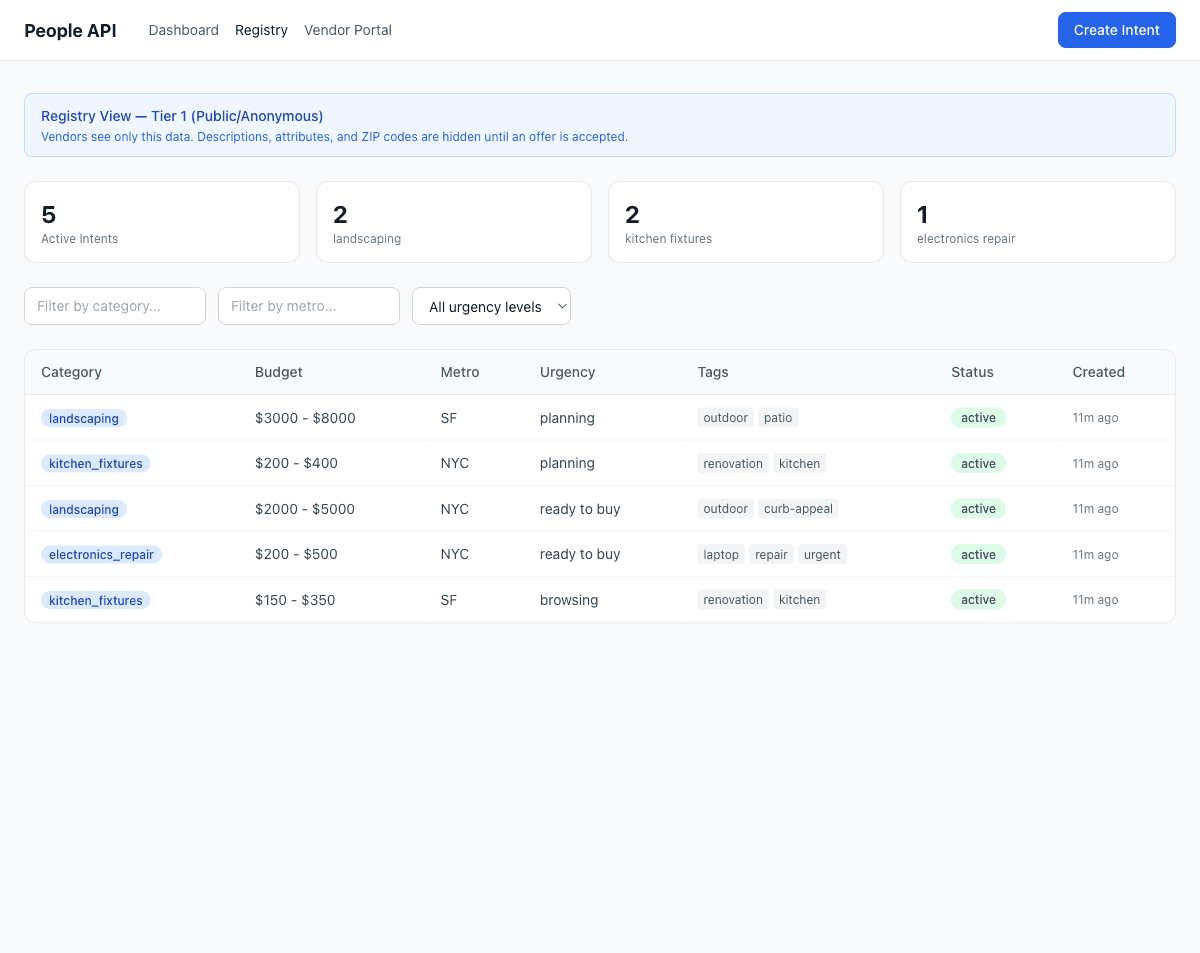
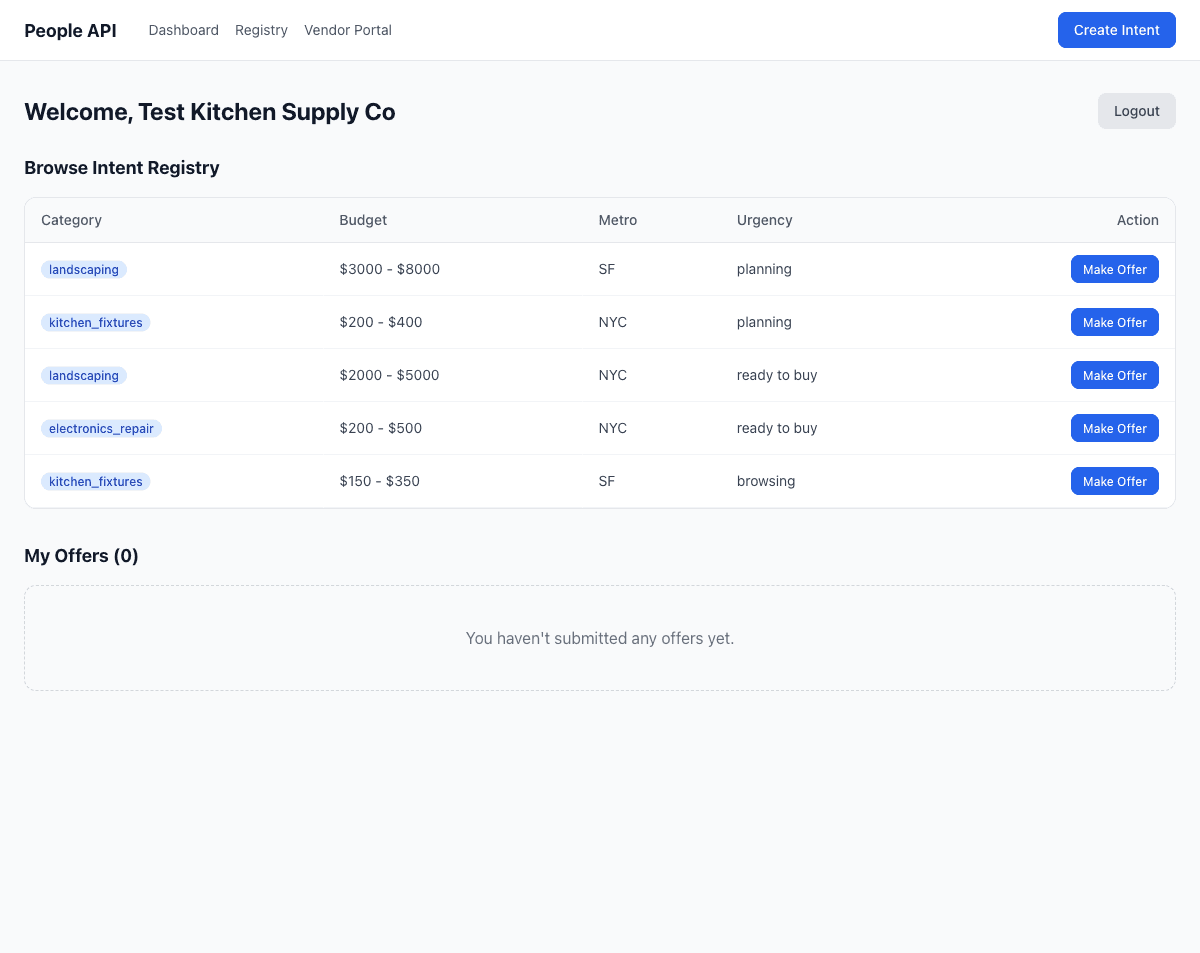
Vendors browse the registry, filter by category, metro, and urgency. They see public fields only.
- 04Vendor
Offer
A vendor submits a structured offer — price, delivery, attributes, an optional alternative. No free-text pitch required.
- 05Server
Score
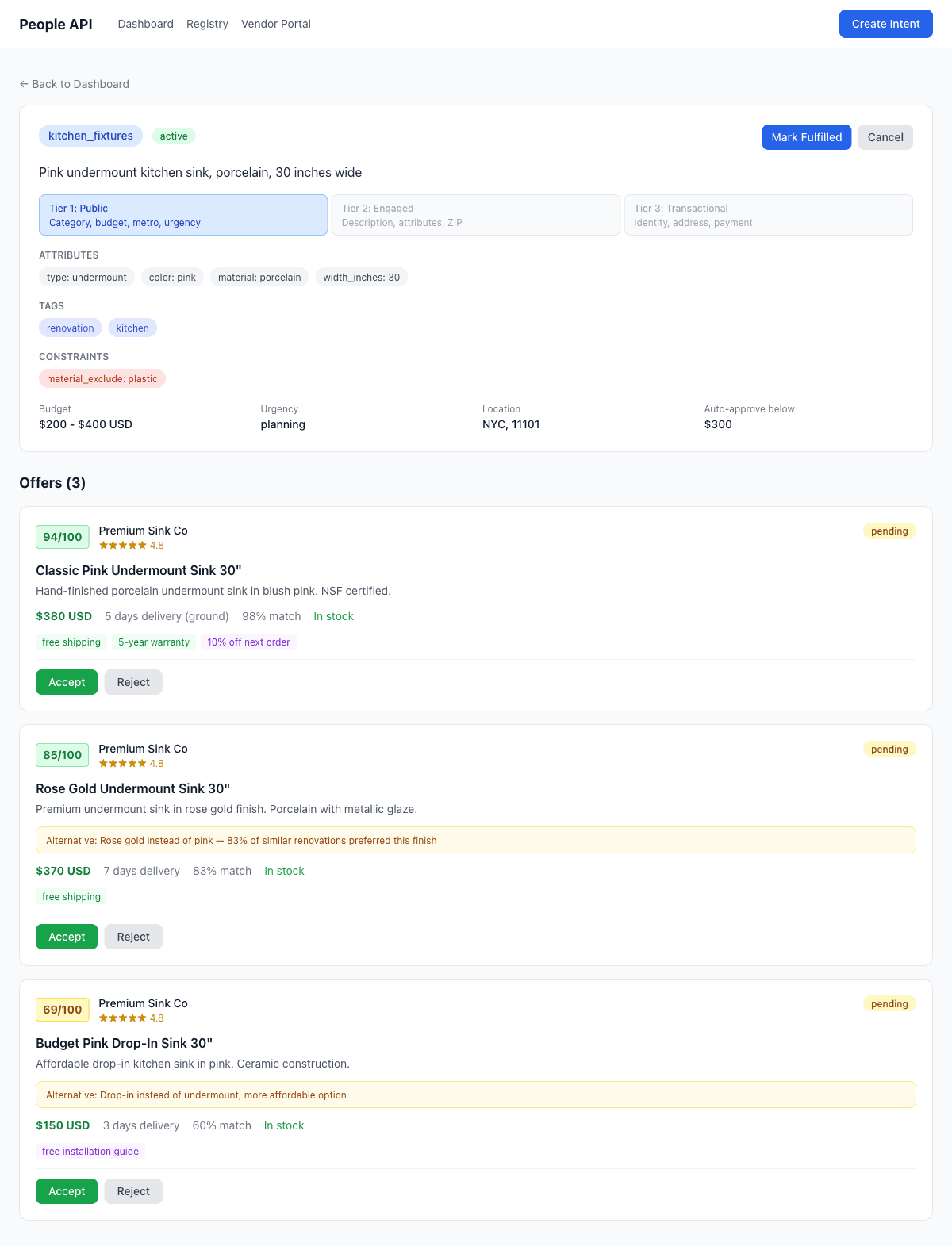
The server scores the offer 0-100 across six factors. Very bad offers are auto-rejected. Qualifying offers under an auto-approve price are auto-accepted.
- 06Tier 2 → 3
Transact
On acceptance, the vendor gets Tier 2 (ZIP + full requirements via session token). Tier 3 (identity, address) unlocks only on confirmed purchase.
Four load-bearing ideas.
A protocol, not a platform.
Self-hostable. Any URL that implements the endpoints is a valid node. Federation is a design goal, not a future feature.
Read the specPrivacy enforced at the protocol level.
Three tiers of progressive disclosure. Vendors can't see who you are until you choose to transact — not by policy, by filter function.
Three tiersScoring is the quality flywheel.
Every offer is scored 0-100. Vendors who match well get Tier 2 access; vendors who spam get auto-rejected before the buyer ever sees them.
The formulaAI agents are first-class.
Ships as an MCP server with six tools. Claude, Cursor, or any MCP-compatible assistant can create intents, view offers, and accept deals natively.
Six toolsEvery offer scored 0-100.
A rule-based engine turns offer noise into a ranked queue. The buyer never sees the bottom 20% because the server refuses them at submission time.
See the full engine- +30Price fitHow close the offer price is to the budget band.
- +25Attribute matchHow well the offer's attributes line up with what the intent specified.
- +15Delivery speedUrgency-weighted delivery window.
- +15Vendor ratingNormalized five-star rating.
- +10In stockBinary — can you ship it today?
- -5Alternative (counter-offer)Flat penalty for proposing a different product.
price ≤ autoApproveBelow AND score ≥ 70. Auto-reject if score < 20, price > 1.5× budget.max, or a material_exclude constraint matches.Boring parts, chosen carefully.
See it running.
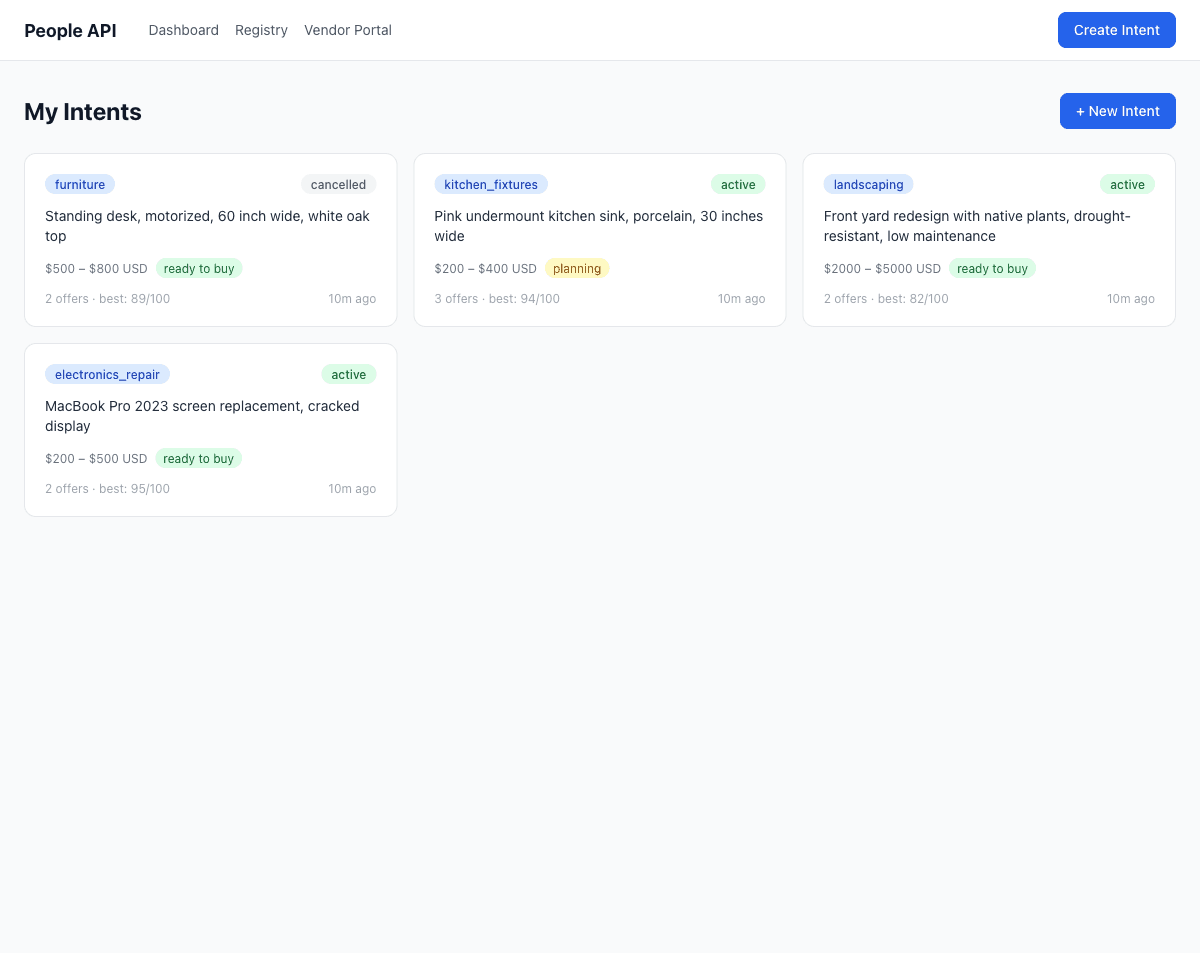
A reference React SPA ships with the server. Five screens, SSE live updates, seeded demo data.
Eight deep-dives.
Ship it
Services got APIs. Now people get them too.
MIT-licensed. Self-host it, fork it, run a private registry for your team.